
Veneers can transform your smile, but which one is the best fit for your budget and lifestyle?
It’s a question that our Spring, TX patients ask about with frequency. Porcelain veneers vs. composite veneers isn’t really a question of which is “best,” but rather which is best for your specific goals and trade-offs.
Porcelain veneers vs. composite veneers simply asks what problem you’re trying to solve and what trade-offs you’re willing to make.
Our Spring, TX patients can find that information right here on our site, exactly as we would if they were sitting in a chair in our office. We tell our patients what each type of restoration is best for, how long each lasts, and what to expect during each procedure at The Tooth Lodge. And most importantly, we give our patients the ability to see the result ahead of time with our AI smile design. Start smart. Ask what problem you’re trying to solve.

Which Veneer Is Best For Which Problem?
There are certain cosmetic issues that no amount of whitening gels or bleaching products can improve. Tetracycline staining, fluorosis, and other types of intrinsic discoloration are caused by internal stains that the whitening agent can’t remove. A veneer will cover those stains. We can also treat chipped or cracked front teeth, small spaces between your teeth, mild crowding (where braces aren’t an option), and worn or worn-down teeth, or those that look short and stubby because of enamel erosion. We can even cover older dental bonding, porcelain fillings, or fillings that have become stained and yellowed since their placement.
Porcelain veneers are thin, ceramic shells that are custom-made in a dental lab, then permanently bonded onto the surface of your front teeth in a multi-appointment process that begins with the removal of a thin layer of tooth enamel. We need to stress, however, that the enamel removal is an irreversible procedure. If enamel is removed from the tooth, you’ll always need the veneer or something else covering the tooth.
Composite veneers, on the other hand, involve sculpting tooth-colored resin onto the front of your teeth in a single appointment. Usually, with little or no enamel removal. If you wish to change your mind in the future and explore other options, in many cases, we can reverse the composite procedure, and your enamel can be restored.
Let’s be clear. Composite veneers are not “temporary” in the sense that they need to be changed every year or so. They’re permanent restorations, with a shorter life expectancy and lifespan than porcelain veneers. They’re attached to the tooth exactly the same way a porcelain veneer is. The only difference is that you’re trading durability and life expectancy for a lower price point.
We work with patients from Windrose, Gleannloch Farms, and Tomball. Some patients are only focused on the cost and affordability of the procedure, while others want a very professional and polished look and feel and don’t mind spending the extra money for the longevity that comes with porcelain. All paths are valid and should be pursued with your best interests in mind.
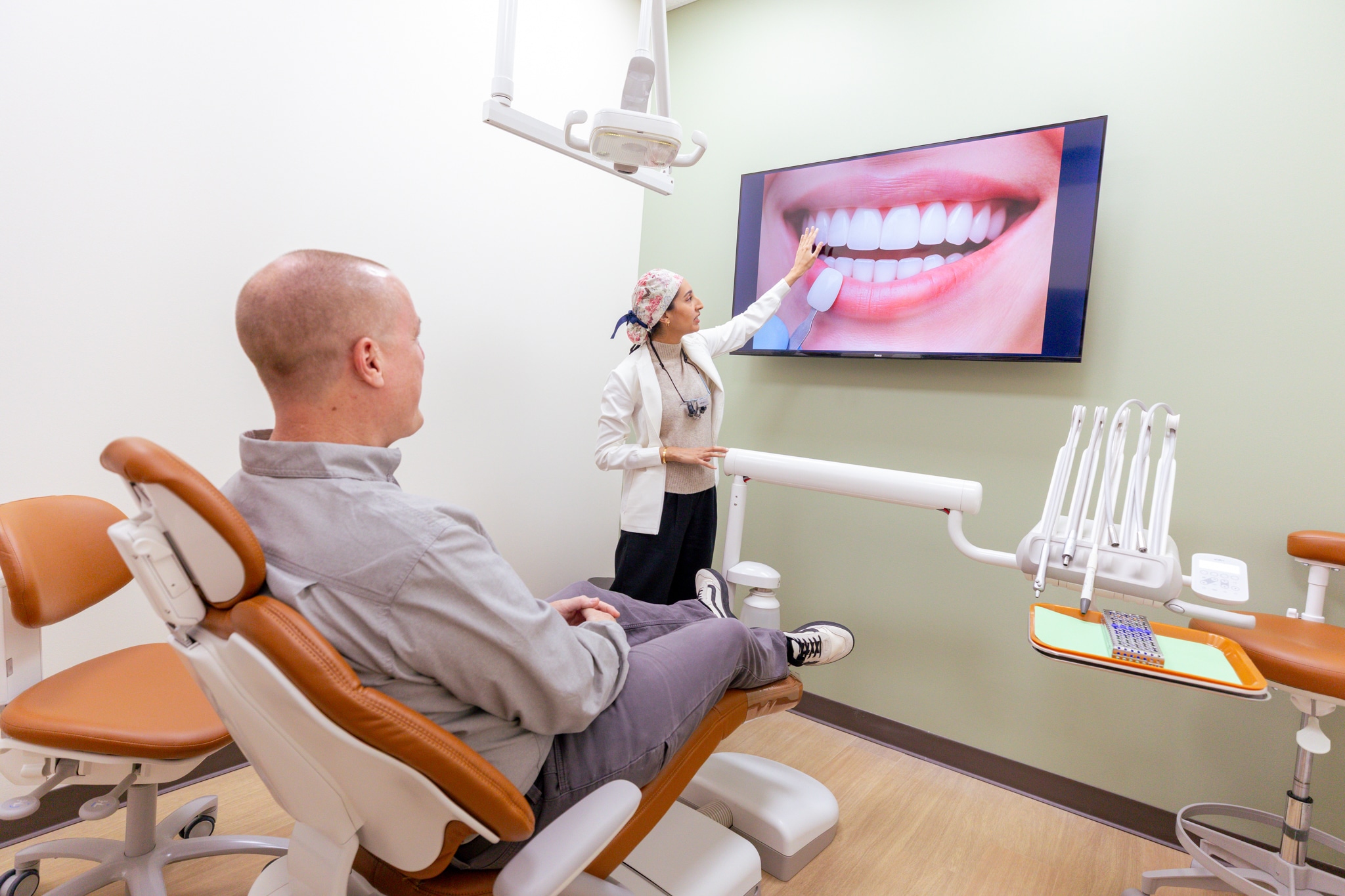
And you don’t need to commit to any decision until you’ve seen the digital results in our AI smile design technology. We can show you your smile design so that you can see what you will look like before we even begin.
Comparing Porcelain & Composite Veneers Based On Key Factors
When deciding between these two restorative options, patients really care about five things: how they look, how long they last, whether the treatment is reversible, whether repairs are possible, and how they handle staining. The following is a straightforward breakdown of each category, presented without the typical generic summary.

How They Look & Feel
Porcelain is the dental material that most closely resembles the way light reflects off natural enamel. The translucency, the optical transmission and diffusion, and even the depth of the color, all carry over into long-term use. High-quality composite has gotten a lot better, and it looks outstanding just after installation. Over time, the resin may develop surface changes or subtle wear patterns, whereas porcelain can stand up to those conditions more easily.
How Long They Last
Per the American Academy of Cosmetic Dentistry, porcelain veneers can last 10 to 20 years if the patient has good dental care. A composite resin may only last five to seven years before any maintenance or replacement is needed. How you use your mouth will also shorten these timelines. If you chew on ice or pens, bite into hard fruit like apples, or drink a lot of dark-colored coffee and wine, those habits will impact the longevity of either type of restoration.
How They Hold Color
This point comes up frequently for my patients in Houston and Spring. We have a lot of iced coffee and cold brew shops on every corner, so people are sipping beverages all day. Porcelain is far less likely to pick up stains than composite resin. That gap widens when patients who have a few cups of coffee a day or more go through those habits. If you regularly start your day with a dark roast, porcelain will maintain its color better over the years.
What Happens If They Chip Or Crack
It is easier to repair a chipped composite veneer, and a qualified dentist can do this in a single chairside visit, typically the same day the patient first brings the issue up. If a porcelain veneer cracks in half or gets chipped, it usually needs replacement. This involves a second lab cycle to fabricate a brand-new veneer to fit the same tooth. It is a critical distinction for athletes and patients who play sports recreationally and have kids who get into things at home.
Bruxism & Teeth Grinding
This is one of the most frequent questions I field: “My old dentist said that I cannot have veneers because I grind my teeth. Is it true that they will not work for me?” Grinding is not a disqualifier; it is a factor to account for when developing your treatment plan. A nightguard can protect the natural teeth and veneers from the damaging effects of bruxism. This is part of the treatment planning we do during your consultation. We will also utilize our digital scanning equipment to capture any existing wear patterns on your teeth, which will indicate whether or not you will require bruxism management.
Commuting a long distance from Spring and nearby areas to receive dental care can also impact what patients are looking for in terms of veneers. People who spend time traveling to their dental appointment often prefer the longevity of porcelain. If you have a full and busy schedule, choosing a veneer material that does not need to be maintained or repaired as frequently is smart.
Our digital scanning and artificial intelligence smile design process helps you see how you will look after treatment and how your smile will evolve over the next 10 to 20 years, whichever veneer type you choose.
Understanding The Porcelain & Composite Veneer Appointment Process From Start To Finish
Understanding your procedure from beginning to end helps you manage any pre-treatment anxiety. This is an outline of what your porcelain or composite veneer appointment at The Tooth Lodge involves, presented from your point of view as a patient.
The Porcelain Veneer Appointment
Consultation & AI smile preview
We will scan your teeth using our Medit scanner (no goopy impressions). During your appointment, we’ll discuss your goals, evaluate your bite, and give you a digital mock-up of your future smile. The appointment will take about 60 to 90 minutes, and you will go home feeling excited and reassured knowing how your smile will look even before we touch an enameled tooth!
Preparation Appointment
We’ll remove a very thin layer of enamel from the facial or front surface of the teeth being veneered. We take digital impressions and provide temporary veneers while your custom veneers are being made in the lab. This appointment takes between 1 and 2 hours, depending on how many teeth we are treating.
Lab Fabrication
This is when your beautiful custom veneers are fabricated. Your veneers will take 1 to 2 weeks to be made. During the fabrication time, you will have temporaries to wear. Try to avoid sticky or hard food as it may cause your temporaries to come off.
Placement Appointment
We will remove your temporaries, permanently cement your new veneers, adjust your bite, and then polish everything. This appointment will take about 60 to 90 minutes.
Follow-Up Check
Your smile check-in is just to ensure everything has bonded well, your bite feels good, and all margins are well sealed. A brief appointment, 15 to 30 minutes.
The Composite Path
Consultation & Shade Matching
Sometimes we can do the consultation and shade matching all in the same visit. Your smile goals will be discussed, and the composite shade will be matched to surrounding teeth. It is usually about 30 to 45 minutes.
Chairside Composite Application
Composite is a resin material, so we’ll actually be placing this right there in the dental chair on your teeth! We build and sculpt your teeth layer by layer with a special light, curing the material in between. Once it’s sculpted into your new smile, we’ll polish everything for a smooth, shiny look. This appointment will take one to two hours, depending on the number of teeth. You’ll leave with your new smile, same day!
Post Placement Expectations
Porcelain patients can experience some sensitivity to temperature for a few days after preparation. With composite, there is almost none. For the first week of wearing your temporaries on the porcelain path, you’ll notice that your temporaries don’t feel and function like your new porcelain veneers, so it does take a bit to get adjusted to them. Full comfort with your final bite and feel happens within the first month of the procedure. A healthy mouth and mouth care habits are essential for optimal smile and oral health longevity, according to the National Institute of Dental and Craniofacial Research.
Patients who have been patients in The Woodlands are familiar with our Medit digital intraoral scanning and CBCT cone-beam imaging technology, as a testament to our emphasis on precision. The preview helps alleviate that unknown before any irreversible procedure takes place!
Default Exclusions:
- Custom nightguards for bruxers are a separate add-on, depending on the individual’s need for the patient.
- Tooth whitening of adjacent teeth before shade selection should be done if desired, before we begin veneer preparations.
- Any untreated caries or periodontal issues will need to be addressed before starting veneers.
We also offer a Netflix and drill program in our office, so patients can enjoy streaming entertainment, noise-canceling headphones, laughing gas, aromatherapy, and even cozy blankets during their appointment. Anxious patients often find the whole thing much easier than they were bracing themselves for.

Veneers Without Dental Insurance Is More Of An Option Than Most Spring Patients Realize
Veneers are a cosmetic procedure. Most dental insurances will not cover them. And we know that is a bummer because we hear it all of the time from patients who would love better smiles but can’t afford them before they even call us.
But we actually do offer an in-house membership plan for patients without insurance to make it a little easier to get preventive care and restorative care, and we can talk about what is covered during your consultation. We also offer financing for larger treatments through Cherry and Sunbit to make those larger treatments much more manageable with easy monthly payments. Those are easy financing options, not something that is hard to deal with. And it gives you a chance to make these treatments available if you can’t pay in full.
If you are more cost-sensitive, the most honest way to do things with composite veneers plus an in-house membership plan is actually still possible. You can get a real cosmetic improvement even on a more modest budget. We are not trying to sell every single patient on porcelain veneers. Composite veneers actually solve problems and do so on a more realistic budget for people.
There is also that other question that most people research before they even call: what is the reason dentists do not want you to get veneers? It really comes down to the fact that there is no exact situation for everyone, and you need to look at that specific patient. It just might not be a good thing for your specific case. If you have a very poor gum situation, or you have a bite that is going to cause you damage to the veneers, or your enamel is very minimal, that is going to be discussed with you in your consultation. There might be periodontal treatment you may need first, or maybe orthodontics, before we ever get to veneers. That is all just a part of the process.
And with the variety of incomes along FM 2920 and further into Magnolia, we can actually do both on all different budgets because our whole office and team are here for both composite and porcelain consultations, and we can make that happen on those different budgets. And we can make sure that you are seeing your AI smile preview and you have that discussion to understand your options. There is no commitment to be made that day. Because Smiles Built On Authentic Care means that you get all the information, and then you decide.
Frequently Asked Questions
It does not matter which is better because both have different pros and cons for both patients. Porcelain veneers offer much better durability and stain resistance, and translucency, so that is ideal if you have a higher budget and you are thinking of a long-term solution. Composite is less expensive, and it does require less tooth structure to be removed; it can be easily repaired if chipped. So it is about what the best choice for the patient is, but really what they are thinking, what their lifestyle is like, and how they want to spend their money. And we discuss that in a consultation with you, where we will have both composite and porcelain available as options and have a digital preview of both.
Typically, they are able to be. Because the amount of tooth structure that is removed for composite veneers is minimal to none, the teeth are left mostly intact. This means if you want porcelain veneers or some other form of treatment later, that option is still available to you. With porcelain veneers, tooth structure is always removed prior to the restoration, so teeth will always require a covering of some kind once veneers have been placed.
Bruxism, or the habitual grinding of teeth, can make the choice more complicated, but it certainly doesn't mean veneers are off-limits. We recommend porcelain veneers over composite because the porcelain is harder and less likely to wear down, but keep in mind that excessive tooth grinding can damage either type. For anyone with a history of grinding, we incorporate a nightguard into the treatment plan to protect the investment. During your consultation, we use digital scanning to map out any current wear patterns, allowing us to adjust the material selection based on the severity of your grinding habits.
A well-cared-for porcelain veneer might still be functioning well after 20 years. However, some patients elect to replace them at that stage, often for a cosmetic update or because of slight wear. In contrast, composite veneers typically need to be touched up or completely replaced well before hitting the 20-year mark, generally falling somewhere in the five to seven-year window. No matter the material, we will examine your veneers closely at each routine check-up. If signs of aging appear, we will discuss what's needed and when a replacement might be the right choice.
The short answer is that you can't remove veneers, but you can have them replaced. Porcelain veneers involve removing the existing ceramic shells and placing new ones, a process that your tooth preparation is already designed to handle. Composite veneers are more malleable; worn-down areas can be buffed away, or new layers of composite can be bonded onto the tooth surface. It's important to remember that veneers aren't truly "removable"—once your porcelain shells are bonded, they stay. You'll never have your natural teeth back because we had to remove some enamel during the initial preparation to accommodate them.
This isn't a common occurrence. Because dental insurance providers generally classify veneers as cosmetic procedures, most policies don't cover them. Very few plans pay anything unless there's significant structural damage requiring the veneer, which is rare. However, patients can choose to access affordable treatment via our membership plan or financing programs like Cherry and Sunbit if they don't have coverage for cosmetic procedures.
We are likely to finish composite veneers in just one visit, which will only take an hour or two. Porcelain veneers require multiple visits spread out over two to three weeks for the consultation, prep, lab fabrication, and final installation. No matter which veneer type you choose, we will walk you through a computerized smile preview at your first visit.
We use this general rule to determine the optimal smile design for veneers. The 4-8-10 rule states that when speaking or laughing at ease, you will show four teeth. When you give a wide smile with friends and family, you'll reveal eight, and in a genuine smile, you'll show a full set of 10. We keep this rule in mind when planning your shade, shape, and smile line, ensuring that your new teeth reflect how you genuinely interact with the world.
Become A Part Of The Family & See Your New Smile Before We Begin
The “Trusted Dentistry With A Personalized Approach” we provide at The Tooth Lodge means you can see exactly how you will look when treatment is finished before we start doing any work. Give us a call if you’d like to schedule a veneer consultation at our office in Spring, TX. We’ll scan your teeth, give you a 3D view of your new smile, and talk with you through all your choices so you can make an informed decision for your future self.